




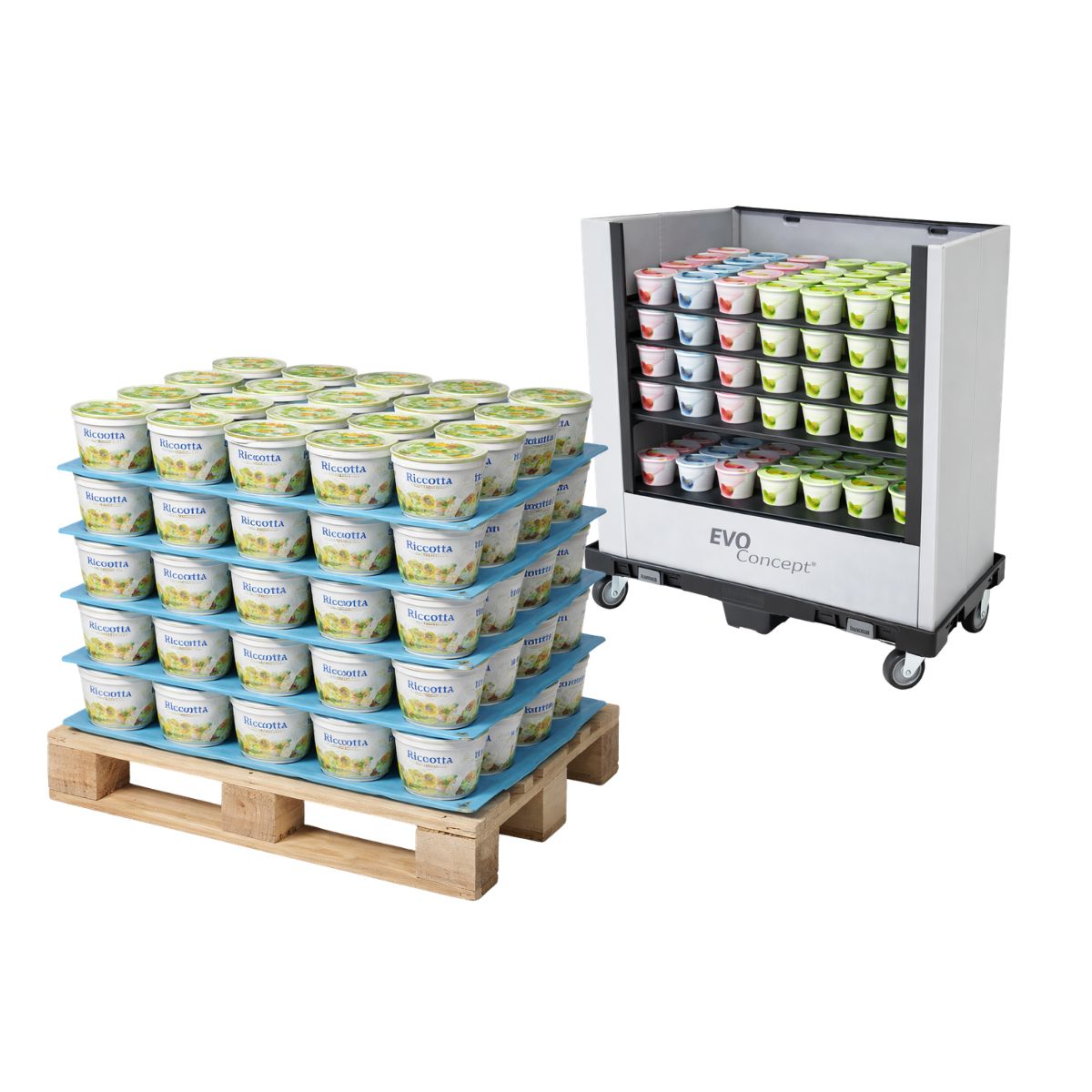


In the dairy sector, particularly in the production of yogurt and fresh cheeses in cups, logistics represents a critical element in ensuring quality, safety, and competitiveness. However, many companies still rely on traditional solutions which, over time, generate operational inefficiencies, hidden costs, and difficulties in managing flows. In this article, we analyze 3 common issues in the sector’s logistics and how to address them with a more efficient and sustainable approach.
1. Deterioration of layer pads and separation materials
Cardboard layer pads are still widely used to separate palletized layers. However, in dairy production environments, these solutions present several limitations: they absorb moisture and liquids, lose rigidity over time, deteriorate quickly during reuse cycles, and generate waste and disposal costs. The result is a reduction in pallet stability and an increase in replacements.
2. Inefficiency in the management of reusable containers
Many companies still use mixed systems (cardboard + rigid plastic) or containers that are not optimized for reuse. This leads to difficulties in cleaning and sanitization, excessive volume in return transport, breakages or premature wear, and poor logistics standardization. All of this results in higher logistics costs and less efficient processes.
3. Non-optimized pallet space and transport
In the yogurt sector, where volumes are high and margins are often tight, every centimeter of pallet space matters. Traditional solutions are often not designed to maximize volumetric efficiency, reduce overall weight, or perfectly adapt to cup formats. The result is wasted space and higher transport costs.
A new approach: reusable technical materials
To overcome these challenges, more and more companies are adopting solutions based on technical plastic materials specifically designed for industrial logistics. The main advantages include resistance to moisture and chemical agents, long service life, ease of cleaning and sanitization, waste reduction, and optimization of weight and space. These features enable more stable, efficient, and sustainable logistics.
Sustainability and reuse: from cost to competitive advantage
One of the most relevant aspects is the shift from a “single-use” model to a reusable system. This makes it possible to reduce operating costs in the medium to long term, improve ESG performance, simplify material management and reduce environmental impact. In many cases, the initial investment is quickly offset by operational benefits.
In addition, a key factor is becoming increasingly important: the European regulatory framework. The new PPWR (Packaging and Packaging Waste Regulation) is driving companies toward reusable solutions and a concrete reduction of packaging waste.
In this context, adopting reusable systems is not only a sustainable choice, but also a way to anticipate future regulatory requirements and make the supply chain more resilient and compliant..
Every logistics system is different: a specific analysis is required
There is no one-size-fits-all solution. Each company has different formats, specific logistics flows, automation requirements, and space and handling constraints. For this reason, the first step is always a concrete analysis of processes.
Let’s discuss your logistics
We are currently analyzing several cases in the yogurt and fresh cheese sector to identify the most effective logistics solutions in terms of efficiency, reuse, and sustainability. If you would like to explore how to optimize layer pads and containers in your supply chain, our team is available for a no-obligation discussion.
We are here to find the right solution for you.
Contact us to learn more about our products and services. Our team is always available to help you choose the packaging solution that best suits your needs, offering personalized support and consultation.
Contact us