




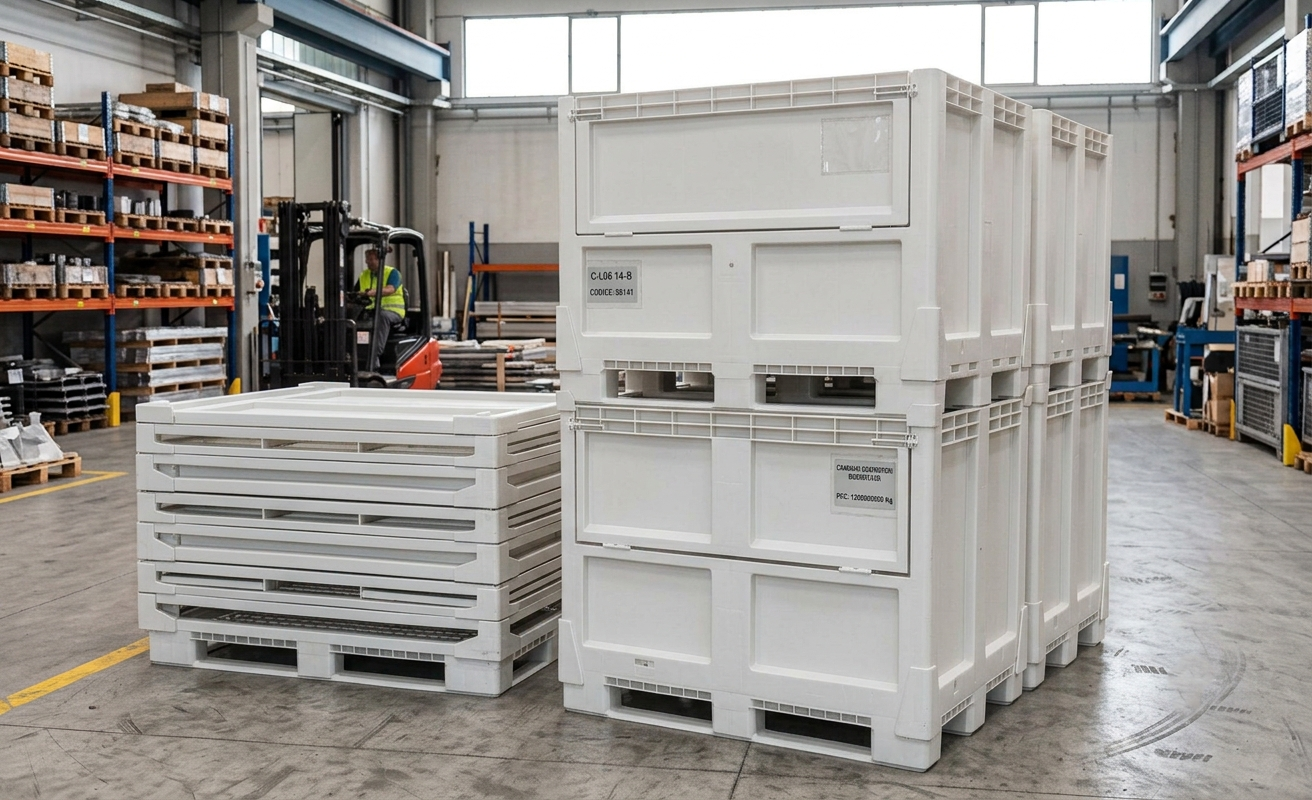


Optimising empty returns is one of the most important challenges in industrial logistics. When containers return without goods, they continue to occupy space on transport vehicles and in warehouses, generating costs that affect the overall efficiency of the supply chain.
Collapsible technical containers represent a concrete solution to reduce bulk, improve organisation and make repeated logistical cycles more sustainable.
The Empty Return Problem
Many industrial companies manage continuous flows between suppliers, production facilities, warehouses and customers. Containers are emptied and must then return to their starting point or be stored awaiting next use.
If the container maintains the same volume even when empty, available space is used inefficiently. This leads to:
- more return trips;
- higher transport costs;
- unnecessary warehouse space occupation;
- greater complexity in flow management.
Reducing the volume of empty containers therefore means directly addressing logistical costs.
Why Choose Collapsible Containers
Collapsible containers are designed to be closed or reduced in volume when not in use. This feature allows the number of containers transportable during empty returns to be increased and storage areas to be freed up.
In high-turnover contexts, this advantage becomes particularly relevant. More efficient management of empty containers improves transport planning, reduces operational times and contributes to more orderly logistics.
The Role of Technical Materials
To guarantee constant performance over time, collapsible containers must be made from resistant yet lightweight materials. Corrugated polypropylene is an effective solution because it combines robustness, low weight and workability.
Among the main advantages of corrugated PP we find:
- lightness, useful for facilitating handling;
- impact resistance, important in repeated logistical cycles;
- hydrophobicity, useful in variable production environments;
- ease of cleaning, for more practical management;
- recyclability, thanks to the single-material nature of the material.
These characteristics make polypropylene suitable for producing durable and reusable technical containers.
Storage Optimisation
In addition to transport, storage also benefits from using collapsible containers. When not in use, closed containers take up less space and can be managed more orderly.
This allows operational areas to be freed up, warehouse activities to be simplified and space availability to be improved.
Customisation and Functionality
Every supply chain has specific needs. Collapsible technical containers can be designed to measure based on dimensions, weight and characteristics of the materials to be transported.
It is possible to integrate internal dividers, closing systems, handles, label areas and modular configurations, improving protection, traceability and ease of use.
Sustainability and Waste Reduction
Reducing volumes during empty returns also means reducing trips, consumption and emissions. Collapsible containers are designed to be reused multiple times, limiting the use of single-use packaging.
Polypropylene, being recyclable at end of life, contributes to a more sustainable logistics model oriented towards the circular economy.
A Strategic Choice for Logistics
Choosing collapsible technical containers means optimising empty returns, improving storage and reducing operational costs.
For companies managing repeated logistical cycles, these solutions represent a concrete investment to make the supply chain more efficient, orderly and sustainable.
We are here to find the right solution for you.
Contact us to learn more about our products and services. Our team is always available to help you choose the packaging solution that best suits your needs, offering personalized support and consultation.
Contact us